
Gym Franchise in India
Updated for 2026 | 500+ Gym & Fitness Franchise Opportunities | Expert Guidance from Franchise Circle
Browse India’s most trusted gym and fitness franchise opportunities across full-format gyms, boutique studios, and hybrid fitness centres — and get started with a Free consultation.
Why Start a Gym Franchise Business in India?
India’s fitness industry has quietly become one of the most compelling consumer sectors to enter in 2026. The India Fitness Market Report 2025, published jointly by Deloitte India and the Health and Fitness Association (HFA), projects the sector to grow from INR 16,200 crore in 2024 to INR 37,700 crore by 2030 — a 15% compound annual growth rate. This isn’t hype-driven growth; it’s being pulled forward by rising health awareness, higher disposable incomes, and a young population that treats fitness as a daily habit rather than an occasional activity.
What makes this opportunity unusually large is the gap between supply and demand. Fitness facility memberships stood at roughly 12.3 million in 2024 and are expected to nearly double to 23.2 million by 2030 — yet current paid fitness participation still covers only about 0.8% of India’s eligible adult population. Very few consumer categories in India show this much headroom between existing infrastructure and latent demand.
A franchise model turns this opportunity into a manageable business rather than a risky bet. Building an independent gym from scratch means creating brand trust from zero, designing your own class curriculum, sourcing equipment on your own terms, and figuring out member retention through trial and error. A franchise instead hands you a recognised brand, a tested training system, an equipment and supplier network, and membership software that’s already been stress-tested elsewhere — cutting down the operational guesswork significantly.
Popular Gym Franchise Formats in India
Full-Format Gym
This is the traditional large gym setup — cardio zones, strength and free weights, group exercise studios, steam rooms, and locker facilities all under one roof. It needs serious space (usually 3,000–7,000 sq. ft.) and a higher investment, but it also serves the widest range of members and commands the highest membership fees.
Compact / Express Gym
Built for residential neighbourhoods and smaller cities, this format trims the footprint to 2,500–4,000 sq. ft. while still delivering a solid member experience. Brands like Snap Fitness and Anytime Fitness have leaned into this model because it keeps operating costs lower without diluting the brand experience — particularly useful in Tier-2 cities where a large gym is harder to justify financially.
Boutique Studio
A boutique studio picks one discipline — HIIT, yoga, boxing, dance, Pilates, or cycling — and goes deep instead of wide. This is currently the fastest-growing segment in Indian fitness, with the HFA report projecting close to 19% annual growth through 2030. Lower space requirements and premium per-class pricing make this an attractive entry point for urban investors working with moderate budgets.
Hybrid / Tech-Enabled Fitness Centre
This format blends physical training with app-based workout tracking, online classes, and AI-assisted fitness planning. Cult.fit is the clearest example in India — members buy into an ecosystem, not just a physical location. The upside is stronger retention through digital engagement, though it does mean tighter integration with the franchisor’s technology platform.
How a Gym Franchise Business Works
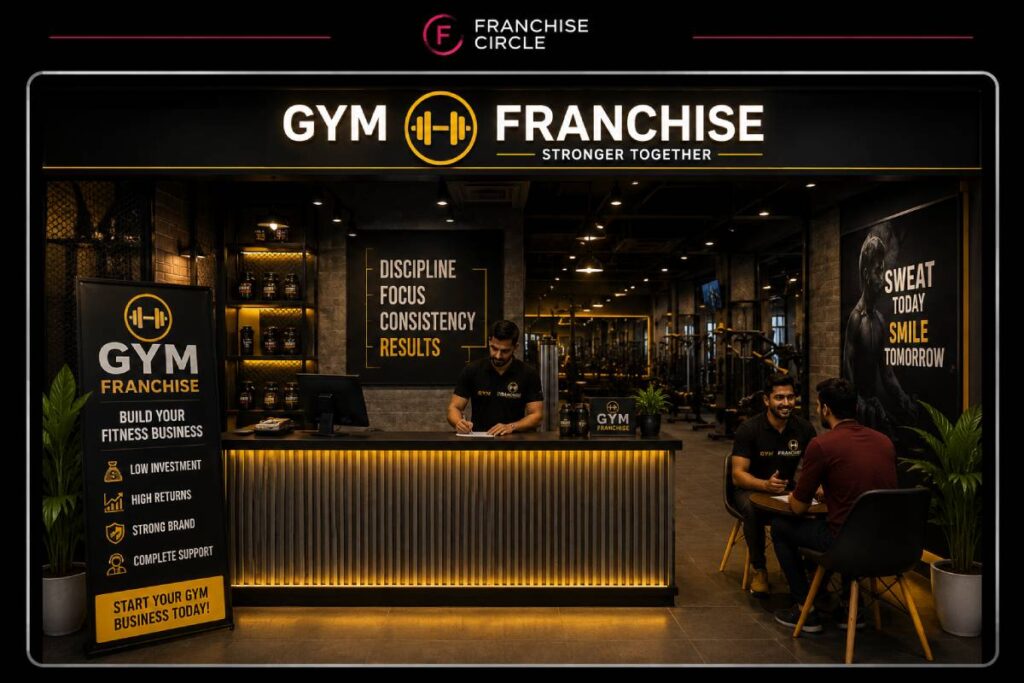
Most gym franchises in India run on a FOFO (Franchise Owned, Franchise Operated) model. The franchisor supplies the brand, workout programming, equipment specifications, trainer certification guidelines, membership software, and marketing support. You, as the franchisee, take care of the location, hiring, day-to-day operations, and local membership sales — you’re running a proven system rather than inventing one.
Once the franchise agreement is signed — typically for a five-year term — the brand usually helps with site fit-out, equipment procurement, and initial staff and trainer training before the doors open. After launch, ongoing support generally includes updated workout programmes, seasonal marketing campaigns, and periodic visits from the franchisor’s operations team. That said, the quality and consistency of this support varies a fair bit between brands, which is why it’s worth asking existing franchisees specifically how support held up after year one — not just during onboarding.
Royalty structures in the gym segment are less standardised than in most other franchise categories. Some brands take a percentage of monthly revenue (typically 6–10%), while others charge a flat monthly fee per member or a fixed monthly royalty regardless of revenue. Anytime Fitness, for instance, is known for its fixed royalty approach, which gives franchisees more predictable cost planning. Getting complete clarity on this structure before signing matters — it can meaningfully shift your unit economics at different membership levels.ए
Gym Franchise Investment in India: What to Expect
Gym franchise investment in India covers a wider range than almost any other franchise category — from compact studios starting near ₹25 lakhs to premium international brands requiring ₹2–5 crore or more. Equipment is the biggest cost driver here, which means setup costs stay largely non-negotiable no matter which brand you pick. Actual investment can vary depending on the city, location, and specific brand requirements.
| Format | Investment Range | Typical Breakeven |
|---|---|---|
| Boutique Studio | ₹25L – ₹60L | 18 – 30 months |
| Compact / Express Gym | ₹50L – ₹1.2Cr | 24 – 36 months |
| Mid-Segment Full Gym | ₹1Cr – ₹2.5Cr | 30 – 42 months |
| Premium International Brand | ₹2.5Cr – ₹5Cr+ | 36 – 48 months |
Working capital planning matters more in gyms than in most franchise categories. A café earns cash from day one; a gym builds its membership base gradually, while rent, staff salaries, and equipment maintenance start from month one regardless of occupancy. Most investors should set aside at least six months of operating costs on top of the setup investment. Once a gym reaches a stable membership level, net margins typically fall in the 25–40% range, though this depends heavily on rent share, location, and pricing strategy. Investors exploring the lower end of this range may also find our franchise under 50 lakhs guide useful.
Benefits of Investing in a Gym Franchise in India
Recurring Membership Revenue
Unlike food or retail businesses that earn revenue transaction by transaction, a gym franchise collects monthly membership income from an already-enrolled base. Once membership stabilises, this revenue becomes largely predictable — members on annual or auto-debit plans provide steady cash flow every month. This predictability makes financial planning noticeably easier than in most other franchise categories.
Massive Untapped Market
Out of India’s roughly 820 million adults aged 18–62, the overwhelming majority are not yet part of any paid fitness programme. Even a modest rise in participation — exactly what Deloitte-HFA projections point to — translates into tens of millions of new potential members nationwide. In Tier-2 cities especially, the first well-branded gym franchise in a residential pocket often captures demand quickly.
Multiple Revenue Streams
A well-run gym franchise earns well beyond the basic membership fee — personal training, group classes, supplements, merchandise, and corporate wellness tie-ups all add to the top line. Cult.fit, for example, has built cross-sell tools into its platform, letting franchisees monetise the same member base through digital content. These additional streams meaningfully improve unit economics.
Strong Community Retention
Fitness is one of the rare business categories where the product itself builds community. Members who train, attend classes, and track progress together tend to stick around far longer than solo users at a typical gym. That social pull keeps retention meaningfully higher than most other subscription businesses — directly protecting the recurring revenue a gym franchise depends on.
Ready to explore gym franchise opportunities? Get Free Consultation
Popular Franchise Opportunities Across India
Explore verified gym franchise brands across categories and investment levels, available across India.
Gym Franchise
Available Across India
Popular Brands:
- Cult.fit (₹1.5Cr–2.5Cr)
- Anytime Fitness (₹2Cr–3Cr)
- Gold’s Gym (₹2.5Cr–4Cr)
- Snap Fitness (₹25L–40L)
Available Across India
Popular Brands:
- Bikanervala (₹50L–2Cr)
- Haldiram (₹30L–50L)
- Wow Momo (₹15L–30L)
- The Belgian Waffle Co. (₹10–20)
Available Across India
Popular Brands:
- Kidzee (₹10L–15L)
- Bachpan Play School (₹8L–12L)
- EuroKids (₹8L–15L)
- Little Millennium (₹12L–15L)
Available Across India
Popular Brands:
- Barista (₹30L–50L)
- Brewbakes (₹10L–12L)
- Coffee Day Xpress (₹5L–8L)
- Blue Tokai (₹20L–30L)
Salon Franchise
Available Across India
Popular Brands:
- Jawed Habib (₹15L–30L)
- Naturals (₹30L–50L)
- Green Trends (₹20L–30L)
- Lakme Salon (₹50L–80L)
Available Across India
Popular Brands:
- Chai Sutta Bar (₹16L–30L)
- MBA Chai Wala (₹8L–25L)
- Chai Point (₹25L–30L)
- Chaayos (₹6L–11L)
Top Gym Franchise Formats Driving Growth in India
Boutique studios are the clear growth story in Indian fitness franchising heading into 2026. Per the Deloitte-HFA report, this segment is expected to grow close to 19% annually through 2030. The appeal comes down to specialisation — members are willing to pay a premium for a focused, community-driven experience in a discipline they actually care about, whether that’s HIIT, yoga, boxing, or Pilates. Lower space requirements combined with strong pricing power make this format worth serious consideration for investors.
The compact express gym format is where the real volume opportunity sits, especially across Tier-2 and Tier-3 cities. Brands like Snap Fitness and Anytime Fitness have been deliberately opening smaller-footprint outlets to serve residential neighbourhoods where a large-format gym wouldn’t make financial sense. These markets also see the least competition from established chains — a well-managed compact gym in a growing residential pocket can build a loyal local base quickly, often at a lower per-member marketing cost than a metro location. Investors working with tighter budgets can check our franchise under 25 lakhs and franchise under 50 lakhs pages for more context.
The hybrid, tech-enabled model that Cult.fit pioneered is reshaping how the whole category thinks about retention. Traditional gyms lean on front-desk conversions and word-of-mouth. A platform-driven model instead uses app-based bookings, AI workout recommendations, and online classes to keep members engaged even outside the gym — a big reason Cult.fit’s retention numbers consistently beat the industry average. Expect more brands to add similar technology layers as the category matures through 2026 and beyond.
Best Cities for a Gym Franchise Business in India
Delhi is one of the strongest gym franchise markets in India — a large, health-conscious middle-class population, strong corporate gym culture, and a well-developed network of residential clusters with established appetite for organised fitness. The broader NCR region, including Noida, Gurgaon, Ghaziabad, and Faridabad, offers strong opportunities for compact gym and boutique studio formats, particularly in high-density residential sectors and near corporate parks.
Mumbai commands premium membership pricing and has a well-established gym culture, particularly in areas like Andheri, Powai, and Navi Mumbai. The city’s fast-paced lifestyle and long commutes also drive strong demand for gyms in residential areas — members prefer facilities close to home rather than travelling across the city. Bangalore is arguably India’s most active market for boutique fitness — the city’s tech-sector workforce is highly health-conscious, early-adopting, and willing to pay for premium, specialised fitness experiences.
Beyond metros, the Deloitte-HFA report specifically calls out the top 10 cities — Mumbai, Delhi NCR, and Bengaluru among them — as accounting for 56% of industry revenue but only 31% of facilities. That gap underlines why Tier-2 cities like Pune, Hyderabad, Lucknow, Jaipur, and Indore are increasingly attractive for gym franchise investment. Infrastructure per capita is lower, the health-awareness wave is arriving, and the cost of entry is meaningfully lower than metros.
Why Now Is a Good Time to Invest in a Gym Franchise in India
The numbers behind entering gym franchising in 2026 are unusually strong. The Deloitte-HFA report projects fitness memberships to grow from 12.3 million today to close to 23.2 million by 2030. Absorbing that near-doubling in just six years requires new facilities — and organised franchise brands are best placed to capture that demand because they offer a consistency of experience that independent gyms typically can’t match.
Government support is adding further tailwind. The Fit India Movement, launched in 2019 and continuously backed since, has played a real role in normalising fitness as a daily habit for India’s middle class beyond just the metro elite. Combined with rising disposable incomes and strong social-media influence from fitness personalities, this policy push has helped shift gym membership from aspirational to mainstream — particularly among the 18–35 age group that now makes up the core gym-going demographic.
The window in Tier-2 cities is still open, but it’s narrowing. Established brands are actively expanding into Lucknow, Jaipur, Indore, and Surat with dedicated Tier-2 expansion programmes offering lower territory fees and stronger onboarding support to attract quality franchisees. Investors who move into these markets now will likely face far less competition than those who wait two or three years. In fast-growing residential pockets of these cities, the first well-branded gym often breaks even faster than a comparable metro investment, simply because local alternatives are still largely unorganised.
Still have questions about tea franchising? Talk to Our Franchise Expert. Talk to Our Experts
How to Choose the Right Gym Franchise in India
Gym franchising involves bigger capital and longer breakeven timelines than most franchise categories — so getting the evaluation right upfront matters more here. Match the format to your budget, location, and how hands-on you want to be, since gym franchising ranges from a compact boutique studio to a full-format gym needing active daily management.
Check Brand Reputation
Visit three or four running outlets and check membership levels, class energy, and staff behaviour. Talk to existing franchisees about real earnings and how the brand supported them after launch — not just during the sales pitch.
Understand Total Investment
The franchise fee is the smallest cost — equipment, interiors, HVAC, and signage add up fast. Ask for an itemised cost sheet and budget separately for six months of working capital before breakeven.
Review Support System
Trainer quality drives retention, so ask about the certification programme and how key trainers get replaced. Also check the member-management app — a good system cuts front-desk workload significantly.
Analyze Market Demand
Gym choices are hyper-local — most members pick one within 2–3 km. Map residential density, count existing gyms nearby, and check footfall patterns before signing, especially near housing societies or IT parks.
Why Trust Franchise Circle?
Registered MSME
Franchise Circle operates as a registered MSME entity, giving investors a verifiable, accountable business to work with.
Franchise Consultants
Our team works directly with investors to match budget, location and risk appetite against the right franchise opportunity.
Brand Verification Process
Every franchise brand listed goes through a basic verification step before being added to our directory.
PAN India Presence
From metro cities to emerging Tier 2 markets, our network covers franchise opportunities across India.
Franchise Circle In Numbers
500+
Franchise Opportunities
2000+
Investors Assisted
100+
Brands Listed
PAN India
Support Network
Franchise Categories Comparison
Compare popular franchise categories — including tea, food, education, coffee, salon and service — based on investment level, risk factor and expected return on investment.
| Category | Investment Level | Risk Level | Typical ROI Period |
|---|---|---|---|
| Food Franchise | Medium to High | Medium | 12 – 24 months |
| Tea Franchise | Low to Medium | Low | 8 – 14 months |
| Education Franchise | Low to Medium | Low | 12 – 18 months |
| Coffee Franchise | Medium | Medium | 12 – 20 months |
| Salon Franchise | Low to Medium | Low | 10 – 16 months |
| Service Franchise | Low | Low | 6 – 12 months |
Expert Reviewed Content
The content on this page has been reviewed by Franchise Circle’s in-house consultants. Market data cited from the Deloitte India and Health & Fitness Association India Fitness Market Report 2025. Investment figures are cross-referenced from multiple independent sources and verified before inclusion. We update these pages as market conditions change.
Author Profile
Franchise Circle’s consulting team has guided investors across tea, food and service franchise categories, with direct experience evaluating brand performance and investment returns across Tier 1 and Tier 2 cities in India.
Franchise Consultants
Expert franchise consultants helping investors choose suitable business opportunities.
MSME Registered
Franchise Circle is a registered MSME supporting entrepreneurs and franchise investors.
5+ Years Experience
Providing franchise consulting and investment guidance for over 5 years.
2000+ Investors Assisted
Helping investors discover profitable franchise opportunities across India.
Reviewed by Franchise Circle Consultants
Related Franchise Resources
Explore additional franchise resources and investment opportunities:
Frequently Asked Questions
What is a gym franchise and how does it work in India?
A gym franchise lets you operate a fitness centre under an established brand’s name, training system, and operational model. The franchisor provides equipment specifications, workout programming, trainer certification, member management software, and marketing support. You manage the location, staff, and day-to-day operations while paying a franchise fee and ongoing royalty.
How much does it cost to start a gym franchise in India?
Investment varies significantly by format. A boutique studio can typically be started for ₹25–60 lakhs, a compact express gym for ₹50 lakhs to ₹1.2 crore, and a mid-format branded gym for ₹1–2.5 crore. Premium international brands like Gold’s Gym or Anytime Fitness typically require ₹2.5–5 crore or more. Equipment is the primary cost driver in all formats.
Which gym franchise is best for investment in India in 2026?
There is no single best answer — the right gym franchise depends on your budget, target city, and long-term goals. Cult.fit offers strong technology and marketing support; Anytime Fitness offers predictable costs and a proven 24/7 model; Snap Fitness is more accessible for mid-budget investors. Profitability depends more on location quality and operational execution than on brand name alone.
What is the breakeven period for a gym franchise in India?
Breakeven timelines can vary depending on format, location, membership ramp-up speed, and how efficiently the business is managed. A boutique studio may typically reach breakeven in approximately 18–30 months. Larger format gyms generally take 30–48 months. Premium international brands with higher investment costs may take longer. Working capital planning for the first six months is essential across all formats.
Do I need to be a fitness professional to own a gym franchise?
No. Most gym franchise brands do not require franchisees to be personally trained fitness professionals. You hire and manage certified trainers — who are supplied, trained, and certified through the franchisor’s programme. What matters most as a franchisee is strong operational management, the ability to build a local member community, and the discipline to follow the brand’s proven systems.
How much space is needed to start a gym franchise in India?
Space requirements vary by format. A boutique studio typically needs 1,500–3,000 sq. ft. A compact express gym usually requires 2,500–4,000 sq. ft. A full-format gym with equipment, group studios, and changing rooms can require anywhere from 5,000 to 10,000 sq. ft. or more. The franchisor typically specifies minimum space requirements and layout guidelines as part of the franchise agreement.
Which cities are best for gym franchise investment in India?
Delhi-NCR, Mumbai, and Bangalore are the strongest metro markets and account for a significant share of India’s organised fitness revenue. Within NCR, Gurgaon and Noida are particularly strong for compact gym and boutique studio formats. Tier-2 cities like Pune, Hyderabad, Jaipur, Lucknow, and Indore are increasingly attractive — lower competition from branded chains, lower entry costs, and rapidly growing health-conscious populations make them strong markets for 2026 investment.
What royalty fees do gym franchises charge in India?
Royalty structures vary across brands. Some charge a percentage of monthly revenue — typically 6–10%. Others charge a fixed monthly fee per member or a flat monthly royalty. Anytime Fitness is known for a fixed royalty model that provides more predictable cost planning. Always clarify the full royalty and fee structure — including any technology, software, or marketing fees — before signing the franchise agreement.
Is a gym franchise profitable in India?
A well-managed gym franchise in a good location can be profitable, with net margins that may typically range from 25–40% once the outlet reaches stable membership. However, actual results can vary considerably depending on location, rent as a percentage of revenue, membership pricing, and how well the gym retains members year-on-year. The Deloitte-HFA report projects gym memberships in India to nearly double by 2030, which provides a strong underlying growth environment for new franchisees entering now.
Can I start a gym franchise under ₹50 lakhs in India?
Yes — boutique studio formats and compact gym models are available in this range. Snap Fitness is typically cited at ₹25–40 lakhs, and certain boutique yoga or fitness studio formats can also be started in this range. Our franchise under 50 lakhs guide covers available options at this investment level.
What are the main risks of investing in a gym franchise in India?
The biggest risks are location-related — a gym in an area with insufficient residential or commercial footfall will struggle to reach breakeven membership. Equipment depreciation, high initial working capital requirements, and member churn in the first year are also common challenges. Partnering with a brand that offers strong post-launch trainer support and active member retention programmes significantly reduces these risks. Speaking with existing franchisees of the brand before signing is the single most effective due diligence step.
How can Franchise Circle help me find the right gym franchise?
Franchise Circle maintains a verified database of gym and fitness franchise opportunities across boutique studio, compact gym, and full-format categories. We help investors match their budget, city, and goals with the right brand — and connect them directly with franchisor teams. Contact us at franchisecircle.in/contact/ for personalised guidance.
Need personal guidance? Contact our franchise consultants.