
Tea Franchise in India
Updated for 2026 | 500+ Tea Franchise Opportunities | Expert Guidance from Franchise Circle
Explore the best tea franchise opportunities in India 2026. Compare investment, ROI and top brands across kiosk, cafe and dine-in formats. Free consultation.
Why Start a Tea Franchise Business in India?
Tea is woven into India’s daily routine in a way few other beverages or foods can match, and that simple cultural fact has turned the tea cafe business into one of the most accessible franchise categories for new investors. What used to be an unbranded roadside stall culture has organised itself over the last decade into kiosks, kulhad cafes and dine-in chains that now sit confidently in malls, college campuses, metro stations and IT parks across the country. Rising disposable incomes, longer working hours away from home and a growing comfort with branded, hygienic food and beverage outlets have all pushed this shift forward, particularly among students and young working professionals in urban India.
What makes tea franchising attractive isn’t just the size of the market — it’s the entry cost relative to almost every other food and beverage category. Most tea franchise formats start well below the investment needed for a full restaurant or QSR outlet, which means investors can test the model, learn day-to-day operations and scale up without taking on the same financial risk as a larger food business. A kiosk-style tea outlet can be up and running within a few weeks of signing, often inside spaces as small as 100 to 200 square feet, which keeps both rent and staffing costs manageable from day one.
Tea also has something most food categories don’t: near-universal, recurring demand that doesn’t dip with the seasons or the broader economy. Office workers, students and commuters need their cup of chai every single day, which gives tea franchise owners a more predictable footfall pattern than many other F&B formats. Combine that with a low average order value that keeps daily walk-ins high and per-cup costs low, and tea becomes one of the few franchise categories where consistent volume alone can sustain healthy margins, even at a small outlet size. If you’re exploring franchise opportunities more broadly, our food franchise in India guide is a useful companion read, since several investors evaluate tea alongside other food formats before deciding where to put their capital.
Popular Tea Franchise Formats
Tea Kiosks & Carts
The most affordable way to enter tea franchising. These compact setups need as little as 100 to 150 square feet and are designed for high-footfall spots like metro stations, office complexes and college gates. Low rent and minimal staffing make this the preferred starting point for first-time investors.
Kulhad & Desi Chai Cafes
Built around India’s nostalgia for earthen-cup chai, this format blends a traditional product with a modern, youth-oriented cafe experience. These outlets typically need 300 to 600 square feet and do well near colleges, IT parks and busy market streets.
Premium Tea Cafes
A full-service, dine-in tea cafe format with seating, an expanded menu, and a more polished interior. These outlets need a larger footprint and bigger upfront investment, but they support higher average order values and a more diverse revenue mix, including snacks and light meals.
Tea Vending & Express Counters
A low-footprint model focused purely on speed and volume, often placed inside corporate offices, hospitals or transit hubs. This format trades menu variety for efficiency, making it suitable for investors who want minimal day-to-day involvement.
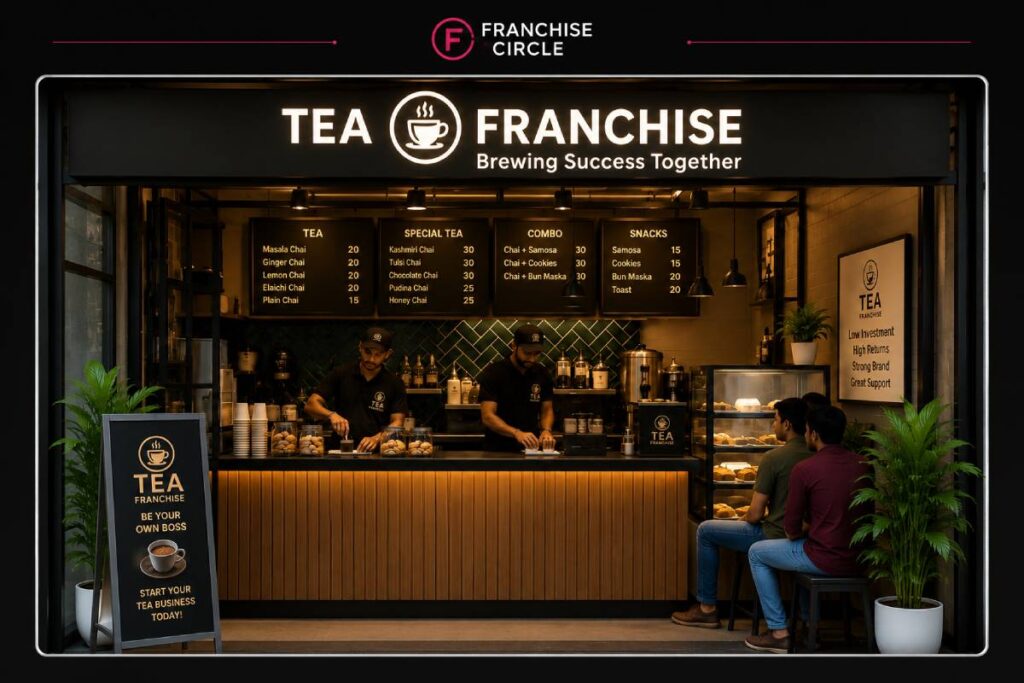
How a Tea Franchise Business Works
A tea franchise generally follows a straightforward franchise-owned, franchise-operated (FOFO) model. You pay a one-time franchise fee for the right to use the brand name, recipes and standard operating procedures, and a separate amount goes toward fitting out your outlet — counters, signage, equipment and initial stock. Once the agreement is signed, most tea brands send a team to evaluate your chosen location for footfall and visibility before approving it.
After location approval, training typically covers tea preparation standards, hygiene protocols and basic customer service, since consistency in taste is what keeps a tea brand’s regulars coming back day after day. Ongoing costs usually include a royalty fee calculated as a percentage of monthly revenue, along with rent, staff salaries and raw material restocking.
Because the product itself has a low per-cup cost and a high margin, profitability in tea franchising tends to come down to footfall and volume more than ticket size — a well-located 150 sq ft kiosk can often outperform a larger outlet sitting in a quieter location. This is one of the clearest differences between tea franchising and heavier food formats like full-service restaurants, where the equation depends much more on average order value.
Tea Franchise Investment in India: What to Expect
Tea franchise investment in India varies significantly based on the format, brand, city and outlet size. Understanding the full cost structure before you commit is critical — the franchise fee is just one part of the picture.
| Format | Investment Range | Typical Breakeven |
|---|---|---|
| Tea Kiosk / Cart | ₹3 Lakhs – ₹10 Lakhs | 6 – 10 months |
| Kulhad / Desi Chai Cafe | ₹10 Lakhs – ₹20 Lakhs | 8 – 14 months |
| Premium Tea Cafe | ₹20 Lakhs – ₹30 Lakhs | 12 – 18 months |
| Vending / Express Counter | ₹1 Lakh – ₹5 Lakhs | 4 – 8 months |
Beyond the initial setup cost, investors should budget for working capital covering at least 3 to 6 months of operating expenses — rent, salaries, raw materials and utilities. Most experienced tea franchise investors recommend keeping this buffer ready before signing a franchise agreement, as early months typically run below breakeven while the outlet builds its regular customer base. Profit margins in tea franchises typically range from 25% to 45%, depending on the format, location and how tightly the operations are managed — lower-investment kiosk and vending formats often deliver higher percentage returns on capital, while larger premium cafes generate higher absolute monthly profits once they stabilise. If your budget sits closer to the premium cafe end, our under ₹20 lakhs and under ₹25 lakhs franchise guides cover several comparable formats outside the tea category worth comparing against.
Benefits of Investing in a Tea Franchise
Low Entry Cost
Tea franchising offers one of the lowest entry points in the food and beverage space, with kiosk formats starting under ₹5 lakhs. This makes it one of the most accessible categories for first-time entrepreneurs and part-time investors.
High-Frequency Repeat Business
Tea is a daily habit for most Indian consumers, which means tea outlets see far more repeat visits per customer than most other food categories — a steady advantage when it comes to predictable monthly revenue.
Compact Space Requirements
Many tea formats operate comfortably in 100 to 300 square feet, which keeps rent costs down and opens up locations — like metro stations and office lobbies — that wouldn’t work for a full restaurant format.
Strong Margins on Low-Cost Inputs
The raw material cost per cup is low, which means tea franchises typically carry higher gross margins than most food categories, even at modest price points.
Ready to explore tea franchise opportunities? Get Free Consultation
Popular Franchise Opportunities Across India
Explore verified tea franchise brands across categories and investment levels, available across India.
Tea Franchise
Available Across India
Popular Brands:
- Chai Sutta Bar (₹16L–30L)
- MBA Chai Wala (₹8L–25L)
- Chai Point (₹25L–30L)
- Chaayos (₹6L–11L)
Available Across India
Popular Brands:
- Bikanervala (₹50L–2Cr)
- Haldiram (₹30L–50L)
- Wow Momo (₹15L–30L)
- The Belgian Waffle Co. (₹10–20)
Education Franchise
Available Across India
Popular Brands:
- Kidzee (₹10L–15L)
- Bachpan Play School (₹8L–12L)
- EuroKids (₹8L–15L)
- Hello Kids (₹6L–10L)
Coffee Franchise
Available Across India
Popular Brands:
- Barista (₹30L–50L)
- Brewbakes (₹10L–12L)
- Coffee Day Xpress (₹5L–8L)
- Blue Tokai (₹20L–30L)
Salon Franchise
Available Across India
Popular Brands:
- Jawed Habib (₹15L–30L)
- Naturals (₹30L–50L)
- Green Trends (₹20L–30L)
- Lakme Salon (₹50L–80L)
Service Franchise
Available Across India
Popular Brands:
- DTDC (₹2L–6L)
- Delhivery (₹1L–5L)
- JustDial (₹2L–5L)
- FirstCry Partner Store (₹15L–25L)
Top Tea Franchise Formats Driving Growth in India
India’s tea franchise market has diversified well beyond the traditional roadside stall, with multiple formats now competing for investor attention — each suited to a different budget and customer base. Kulhad and desi chai cafes remain the most talked-about segment, driven by their strong social media presence and appeal among college-going and young working professionals across Tier 1 and Tier 2 cities.
Kiosk and cart formats continue to attract first-time investors because of their low entry cost and fast setup time, often becoming operational within a few weeks of signing. These formats work particularly well in metro stations, office complexes and high-footfall street corners where space is limited but daily walk-ins are high.
Premium tea cafes, meanwhile, are growing steadily in IT parks and business districts, where customers are willing to spend more for a sit-down experience with an expanded food and beverage menu. It’s worth noting that format matters more than brand size when evaluating tea franchise ROI — a ₹3 lakh kiosk generating consistent daily volume can often deliver a faster payback period than a larger premium cafe with higher absolute revenue but slower footfall recovery. Investors who understand this distinction tend to make better decisions about which format fits their capital and income goals. If you’re weighing tea against other low-investment options, our under ₹5 lakhs and under ₹10 lakhs franchise guides cover several comparable formats side by side.
Best Cities for Tea Franchise Business in India
Tea franchise demand tends to follow two kinds of locations: dense student and young-professional clusters, and cities with strong office and IT-park density. Delhi, Noida, Gurgaon, Ghaziabad and Faridabad together make up one of the strongest tea franchise markets in the country, driven by long working hours and a packed office calendar that creates steady, repeat demand for a quick chai break throughout the day.
Mumbai offers dense footfall around railway stations and commercial hubs that suits kiosk and vending formats particularly well, while Bangalore‘s IT-park culture has made it one of the fastest-growing markets for premium, sit-down tea cafes aimed at working professionals.
Beyond the metros, Indore and Bhopal have become unexpectedly strong markets too — several major kulhad chai brands actually originated in Madhya Pradesh, and the cultural familiarity with chai as a social ritual gives these cities an advantage that’s hard to replicate elsewhere. College towns such as Lucknow, Jaipur and Chandigarh also perform well for kiosk and kulhad formats, since tea remains the default, affordable hangout drink for students.
Why Now Is a Good Time to Invest in a Tea Franchise
India’s tea market continues to expand on a simple, durable fact: tea remains a daily habit in the overwhelming majority of Indian households, making it one of the few food and beverage categories with genuinely universal demand. Branded tea cafes are capturing a growing share of this market as urban consumers, particularly younger ones, increasingly prefer a consistent, hygienic experience over an unbranded roadside stall.
This shift has been accelerated by social media, where kulhad chai and aesthetic tea cafes have become a genuine cultural moment rather than a passing trend, helping several brands scale into hundreds of outlets within a few years of launching. At the same time, the format’s low capital requirement means new investors can enter the category without the financial exposure that comes with a full restaurant or QSR investment.
For someone evaluating their first franchise investment, tea offers a rare combination: proven, recurring daily demand, multiple price points to enter at, and considerable room to grow into Tier 2 and Tier 3 cities where organised tea cafes have only recently started appearing.
Still have questions about tea franchising? Talk to Our Franchise Expert. Talk to Our Experts
How To Choose the Right Tea Franchise in India
Before committing to a tea franchise, evaluate the brand’s existing outlet performance — not just their marketing claims. Ask for contact details of current franchisees and speak to them directly about support quality, actual monthly earnings and any operational challenges they’ve faced. Match the franchise format to your available capital, location and how hands-on you want to be in daily operations, since tea franchising spans everything from a 100 sq ft unattended kiosk to a full sit-down cafe requiring active management.
Check Brand Reputation
For tea franchises specifically, look beyond outlet count and check how long the brand has operated, how existing franchisees describe their experience, and whether quality stays consistent across locations.
Understand Total Investment
Tea franchise investment includes franchise fee, counter and equipment costs, signage, initial stock and working capital for at least 3 to 6 months of operations. Never calculate only the headline franchise fee.
Review Support System
A good tea franchise should offer real operational support — staff training, recipe standardisation and help with location evaluation — not just a brand name and a logo. Quality varies significantly between brands.
Analyze Market Demand
Visit your shortlisted location at different times of day before committing. Tea demand is highly time-sensitive, with sharp peaks around morning, lunch and evening hours, so footfall observed during a single visit can be misleading.
Why Trust Franchise Circle?
Registered MSME
Franchise Circle operates as a registered MSME entity, giving investors a verifiable, accountable business to work with.
Franchise Consultants
Our team works directly with investors to match budget, location and risk appetite against the right franchise opportunity.
Brand Verification Process
Every franchise brand listed goes through a basic verification step before being added to our directory.
PAN India Presence
From metro cities to emerging Tier 2 markets, our network covers franchise opportunities across India.
Franchise Circle In Numbers
500+
Franchise Opportunities
2000+
Investors Assisted
100+
Brands Listed
PAN India
Support Network
Franchise Categories Comparison
Compare popular franchise categories — including tea, food, education, coffee, salon and service — based on investment level, risk factor and expected return on investment.
| Category | Investment Level | Risk Level | Typical ROI Period |
|---|---|---|---|
| Food Franchise | Medium to High | Medium | 12 – 24 months |
| Tea Franchise | Low to Medium | Low | 8 – 14 months |
| Education Franchise | Low to Medium | Low | 12 – 18 months |
| Coffee Franchise | Medium | Medium | 12 – 20 months |
| Salon Franchise | Low to Medium | Low | 10 – 16 months |
| Service Franchise | Low | Low | 6 – 12 months |
Expert Reviewed Content
This content has been reviewed by Franchise Circle’s consulting team with direct experience evaluating tea franchise brands across India. Our consultants have assessed investment structures, royalty models and franchisor support systems across kiosk, kulhad cafe and premium cafe formats to help investors make informed decisions.
Author Profile
Franchise Circle’s consulting team has guided investors across tea, food and service franchise categories, with direct experience evaluating brand performance and investment returns across Tier 1 and Tier 2 cities in India.
Franchise Consultants
Expert franchise consultants helping investors choose suitable business opportunities.
MSME Registered
Franchise Circle is a registered MSME supporting entrepreneurs and franchise investors.
5+ Years Experience
Providing franchise consulting and investment guidance for over 5 years.
2000+ Investors Assisted
Helping investors discover profitable franchise opportunities across India.
Reviewed by Franchise Circle Consultants
Related Franchise Resources
Explore additional franchise resources and investment opportunities:
Frequently Asked Questions
What is a tea franchise and how does it work in India?
A tea franchise lets you operate a branded tea outlet using an established brand’s recipes, training and operating systems, in exchange for a franchise fee and ongoing royalty.
How much does it cost to start a tea franchise in India?
The typical tea franchise cost in India ranges from ₹1 lakh for a small vending counter to ₹30 lakhs for a premium dine-in cafe, depending on the format and brand.
Which is the best tea franchise in India in 2026?
Profitability depends more on location and footfall than brand size — a well-placed kiosk can outperform a larger cafe in a low-footfall area. Brands with consistent quality and strong repeat-customer habits tend to perform best.
What is the breakeven period for a tea franchise in India?
Most tea kiosks and carts break even within 6 to 10 months, while larger premium cafe formats can take 12 to 18 months depending on rent and footfall.
Do I need prior cafe or food service experience to start a tea franchise?
No. Most tea brands provide complete training covering preparation standards, hygiene and customer service, so prior experience is helpful but not mandatory.
What is the typical franchise agreement tenure for a tea franchise in India?
Most tea franchise agreements in India run for 3 to 5 years, with an option to renew based on outlet performance and mutual agreement between the franchisor and franchisee.
Is GST registration required to start a tea franchise in India?
Most tea franchise agreements in India run for 3 to 5 years, with an option to renew based on outlet performance and mutual agreement between the franchisor and franchisee.
Which cities are best for tea franchise investment in India?
Yes. Most franchisors require GST registration before signing the agreement, since it is needed for billing, supply procurement and statutory compliance once the outlet is operational.
Can I start a tea franchise under ₹5 lakhs in India?
Yes. Several kiosk and vending counter formats are available under ₹5 lakhs, making tea one of the most accessible franchise categories for first-time investors.
How can Franchise Circle help me find the right tea franchise?
Franchise Circle connects investors with verified tea franchise brands matched to their budget, location preferences and risk appetite, and supports the process from shortlisting through to franchise agreement.
What are the risks of investing in a tea franchise in India?
Key risks include over-reliance on a single high-footfall location, rising rent in prime areas, and competition from unbranded local tea stalls. Choosing the right location matters more in tea franchising than in most other food categories.
How can I get in touch with Franchise Circle for tea franchise guidance?
You can reach Franchise Circle through the contact form on this page or via WhatsApp for a free, no-obligation consultation with our franchise team.
Need personal guidance? Contact our franchise consultants.