
Coffee Franchise in India
Updated for 2026 | 500+ Coffee Franchise Opportunities | Expert Guidance from Franchise Circle
Browse India’s most trusted coffee franchise opportunities across café, kiosk, and specialty formats — and get started with a Free consultation.
Why Start a Coffee Franchise Business in India?
India has quietly been undergoing a café revolution. While the country remains a tea-first nation in terms of raw consumption, domestic coffee culture has been growing steadily — domestic coffee consumption has seen a 7–10% annual increase, fuelled by urbanisation, rising disposable incomes, and the expansion of café chains into cities large and small. For investors, this shift in consumer behaviour is creating real opportunity at the ground level.
The numbers back this up. According to IMARC Group, India’s coffee market reached USD 9.53 billion in 2025 and is projected to reach USD 17.31 billion by 2034, growing at a CAGR of approximately 6.86%. That kind of sustained trajectory is not built on trend — it reflects a structural change in how urban Indians choose to spend time and money outside the home.
What makes a coffee franchise particularly attractive in this environment is the lifestyle dimension. Cafés have become social infrastructure — places where students study, professionals hold informal meetings, and families catch up on weekends. India has over 600 million people under the age of 35, and a large proportion of them are active café visitors. That demographic base is not shrinking. For an investor who picks the right brand and location, this is a business with compounding local goodwill built into it.
Popular Coffee Franchise Formats in India
Full Cafe Format
The most recognisable format — a sit-down café with a complete menu of hot and cold beverages, light food, and a distinct interior design. These require the most space (typically 600–1,500 sq. ft.) and carry a higher investment, but they also build stronger customer loyalty and allow for longer per-customer dwell time, which translates to higher average bills.
Kiosk and Express Format
A compact, lower-investment option designed for high-footfall locations like malls, airports, office complexes, and railway stations. Brands like Coffee Day Xpress operate successfully in this format with investments that can start under ₹10 lakhs. Lower setup cost and simpler operations make this a popular entry point for first-time investors.
Specialty / Third Wave Café
Focused on single-origin beans, artisanal brewing, and an educated coffee experience. The “third wave” coffee movement is reshaping consumer preferences, with growing appetite for single-origin beans, artisanal brewing methods, and café-style experiences. Brands like Blue Tokai and Third Wave Coffee sit in this segment.
Cafe-Bakery Hybrid
A growing format that combines coffee with fresh baked goods, desserts, or light meals. Brands like Brewbakes fall into this category. The wider menu increases the average transaction value and draws in a broader customer base — including those who might not come purely for coffee.
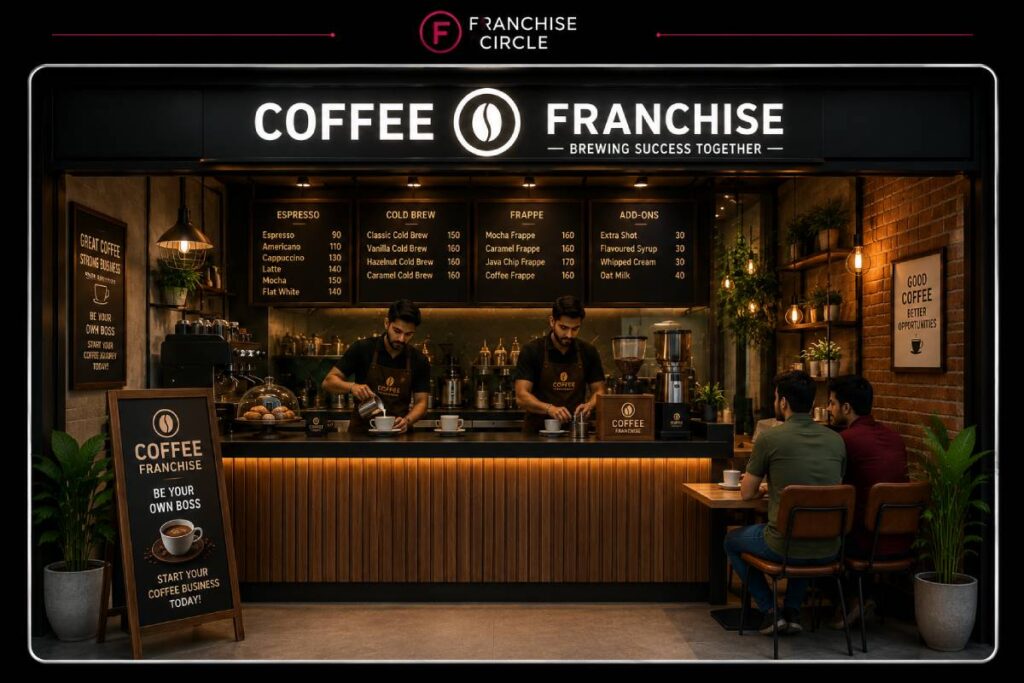
How a Coffee Franchise Business Works
Most coffee franchises in India operate on a FOFO (Franchise Owned, Franchise Operated) model. The franchisor provides the brand, menu, supplier relationships, equipment specifications, staff training, and marketing guidelines. The franchisee handles the location, local operations, and day-to-day management. You’re not building a café from scratch — you’re plugging into a proven system with an existing customer base.
After signing a franchise agreement (typically for a term of three to five years), the brand’s team assists with shop design, interior setup, equipment procurement, and an initial training programme for staff before launch. Most established coffee brands also have centralised supply chains for key ingredients, ensuring consistency of taste across all outlets — which is a significant advantage over running an independent café.
Royalty structures in the coffee segment typically range from 6% to 10% of monthly gross sales, depending on the brand. Some brands also charge a marketing fee of 1–2% on top of the royalty. The major ongoing cost beyond royalties is rent, which in high-footfall locations can be significant. This is why location analysis — evaluating footfall, nearby competition, and customer profile — is arguably the most important decision you will make as a coffee franchise investor.
Coffee Franchise Investment in India: What to Expect
Coffee franchise investment in India covers a wide range — from under ₹10 lakhs for a kiosk format to ₹1 crore or more for a premium international brand. The table below covers the formats most relevant to mid-budget investors, along with approximate breakeven timelines that can vary depending on location, footfall, and local management quality.
| Format | Investment Range | Typical Breakeven |
|---|---|---|
| Kiosk / Express Format | ₹5L – ₹12L | 10 – 18 months |
| Café-Bakery Hybrid | ₹10L – ₹20L | 15 – 24 months |
| Mid-Segment Full Café | ₹20L – ₹50L | 18 – 30 months |
| Specialty / Third Wave Café | ₹25L – ₹50L | 18 – 30 months |
| Premium International Brand | ₹75L – ₹1.5Cr+ | 30 – 48 months |
Beyond the setup cost, working capital for the first three to six months is important to budget for — covering rent, staff salaries, and supply costs before the outlet reaches steady footfall. For a kiosk format, this buffer is typically ₹1–3 lakhs; for a full café, plan for ₹4–8 lakhs. Net margins at a well-run mid-segment café can typically be in the 20–35% range once the outlet is at steady state — though actual results can vary depending on location, rent, and operational efficiency. Investors exploring the entry-level range can find suitable options in our franchise under 10 lakhs guide, while mid-range investors may find the franchise under 20 lakhs page useful for comparison.
Benefits of Investing in a Coffee Franchise in India
Growing Urban Consumer Base
India’s café culture is no longer limited to metros. Tier-2 and Tier-3 cities are seeing the fastest café growth, driven by increasing demand for branded café experiences among younger, aspirational consumers. This expanding footprint means investors in smaller cities can enter markets that are less saturated but rapidly growing — often with lower property costs than metro locations.
Established Brand and Supply Chain
Starting an independent café requires building brand recognition from zero and negotiating supplier terms on your own. A coffee franchise gives you access to a tested recipe, recognised brand name, and centralised supply chain from day one — reducing quality-consistency risk and shortening the time to first customers significantly.
Multiple Revenue Streams
A well-set-up café franchise generates income not just from beverages but also from packaged products, merchandise, and corporate supply arrangements. Several brands have diversified into FMCG retail alongside their café operations, giving franchisees additional revenue channels beyond walk-in customers.
Lower Operational Complexity Than Food
Compared to a full-service restaurant, a coffee café has a simpler menu, lower food wastage, and faster table turnover. This makes daily operations more manageable for first-time business owners. The supply chain is also simpler — coffee, milk, and baked goods versus a full kitchen — which keeps staffing requirements and kitchen equipment costs lower.
Ready to explore coffee franchise opportunities? Get Free Consultation
Popular Coffee Franchise Brands in India
Explore verified coffee franchise brands across categories and investment levels, available across India.
Available Across India
Popular Brands:
- Chai Sutta Bar (₹16L–30L)
- MBA Chai Wala (₹8L–25L)
- Chai Point (₹25L–30L)
- Chaayos (₹6L–11L)
Available Across India
Popular Brands:
- Bikanervala (₹50L–2Cr)
- Haldiram (₹30L–50L)
- Wow Momo (₹15L–30L)
- The Belgian Waffle Co. (₹10–20)
Available Across India
Popular Brands:
- Kidzee (₹10L–15L)
- Bachpan Play School (₹8L–12L)
- EuroKids (₹8L–15L)
- Hello Kids (₹6L–10L)
Coffee Franchise
Available Across India
Popular Brands:
- Barista (₹30L–50L)
- Brewbakes (₹10L–12L)
- Coffee Day Xpress (₹5L–8L)
- Blue Tokai (₹20L–30L)
Salon Franchise
Available Across India
Popular Brands:
- Jawed Habib (₹15L–30L)
- Naturals (₹30L–50L)
- Green Trends (₹20L–30L)
- Lakme Salon (₹50L–80L)
Service Franchise
Available Across India
Popular Brands:
- DTDC (₹2L–6L)
- Delhivery (₹1L–5L)
- JustDial (₹2L–5L)
- FirstCry Partner Store (₹15L–25L)
Top Coffee Franchise Formats Driving Growth in India
The kiosk and express format has been the biggest driver of coffee franchise expansion in India over the last five years. Brands like Coffee Day Xpress have demonstrated that a compact, well-located outlet in a mall or transit hub can generate strong revenue with a much lower investment than a full café. For investors looking at options under ₹15 lakhs, the franchise under 15 lakhs guide covers kiosk-format opportunities in detail.
The third wave specialty café format is where the most interesting growth story is unfolding for 2026 and beyond. Third Wave Coffee surpassed its target and expanded its footprint to 165 outlets across 12 cities in July 2025, creating new lifestyle destinations for coffee enthusiasts. The appetite for single-origin, artisanal coffee experiences is no longer restricted to a niche audience — it is increasingly mainstream among urban millennials and Gen Z consumers in both metros and larger Tier-2 cities.
The café-bakery hybrid is worth serious consideration for investors who want higher average transaction values. By pairing coffee with freshly baked items, these outlets attract not just coffee drinkers but also people looking for a quick breakfast, mid-morning snack, or an afternoon treat. This broadens the addressable customer base significantly compared to a pure coffee outlet, and it keeps tables occupied across more hours of the day — which directly improves daily revenue per square foot.
Best Cities for a Coffee Franchise Business in India
Delhi is one of the strongest markets for coffee franchising in India, combining a large working professional population, strong café culture in neighbourhoods like Connaught Place, Hauz Khas, and Cyber Hub, and year-round demand driven by the city’s mix of students, corporates, and young families. The broader NCR market — including Noida, Gurgaon, Ghaziabad, and Faridabad — is particularly active, with Gurgaon and Noida standing out as high-potential markets due to their dense corporate office clusters and young residential populations.
Mumbai offers premium pricing power for coffee — consumers in South Mumbai and Bandra expect and pay for quality café experiences, making it a strong market for specialty and full-café formats. The city’s pace of life also supports strong takeaway volumes, which benefits kiosk formats in busy transit zones.
Bangalore is arguably India’s most café-dense city and has deep cultural roots in filter coffee alongside a thriving modern café scene. The city’s large tech workforce creates consistent weekday footfall in office-proximate locations. Beyond metros, Tier-2 cities including Pune, Hyderabad, Indore, and Jaipur are increasingly attractive — lower rental costs, growing young populations, and limited competition from established chains make them strong markets for mid-segment coffee franchise investment in 2026.
Why Now Is a Good Time to Invest in a Coffee Franchise in India
India’s out-of-home coffee market is on a particularly strong growth trajectory. According to IBEF, India’s out-of-home coffee market is expected to grow at a CAGR of 15–20%, potentially reaching USD 2.6–3.2 billion by 2028. That rate of growth in the out-of-home segment specifically — the cafés, outlets, and kiosks where franchise businesses operate — is significantly faster than the overall coffee market, and it reflects a real shift in consumer behaviour rather than just market projection.
The competitive landscape in Indian coffee franchising is still relatively open compared to mature markets. In major metros, established brands are well represented — but the Tier-2 expansion race is still in its early stages. Brands are actively incentivising franchisees to open in cities like Indore, Jaipur, Nashik, and Coimbatore, often with lower territory fees and stronger onboarding support. Investors who enter these markets in 2026 are likely to have significantly fewer direct competitors than those who wait another two or three years.
Consumer spending patterns are also working in the café sector’s favour. India’s per capita income has been rising steadily, particularly among the urban middle class, supporting increased spending on lifestyle and leisure. Cafés sit at the intersection of lifestyle and routine — they are aspirational but affordable, which makes them relatively resilient to economic fluctuations. For an investor looking at a food and beverage business, a coffee franchise carries meaningfully lower volatility risk than a full-service restaurant format.
Still have questions about coffee franchising in India? Talk to Our Experts
How to Choose the Right Coffee Franchise in India
Choosing a coffee franchise is as much about location and format fit as it is about brand. A premium specialty brand placed in a low-income neighbourhood, or a kiosk format in a low-footfall location, will struggle regardless of the brand’s reputation. The evaluation needs to cover both the franchisor and the specific site together.
Check Brand Reputation
Visit at least three or four existing outlets of the brand as a customer. Observe footfall, customer experience, and staff interaction. Speak with current franchisees to understand the actual support they receive after launch.
Understand Total Investment
The franchise fee is only one part of the investment. Ask for a complete cost breakdown, including interiors, equipment, inventory, training, and working capital. Plan for at least the first few months of operating expenses before the outlet becomes stable.
Review Support System
Evaluate the quality of post-launch support offered by the brand. Ask about field visits, staff training, marketing assistance, operational guidance, and how quickly the team responds when support is required.
Analyze Market Demand
Coffee franchise success depends on the local market. Study footfall, customer demographics, nearby offices or colleges, and existing competitors before selecting your outlet location.
Why Trust Franchise Circle?
Registered MSME
Franchise Circle is a registered MSME business. When you work with us, you partner with a verified franchise platform—not just a lead-generation website.
Franchise Consultants
Our experienced team helps investors evaluate franchise opportunities with practical insights, market knowledge, and real business experience.
Brand Verification Process
Every franchise brand is independently verified before recommendation. We review investment details, brand support, and business credibility.
PAN India Presence
Franchise Circle connects investors with franchise opportunities across metros, Tier-2, and Tier-3 cities throughout India.
Franchise Circle In Numbers
500+
Franchise Opportunities
2000+
Investors Assisted
100+
Brands Listed
PAN India
Support Network
Franchise Categories Comparison
Compare popular franchise categories — including tea, food, education, coffee, salon and service — based on investment level, risk factor and expected return on investment.
| Category | Investment Level | Risk Level | Typical ROI Period |
|---|---|---|---|
| Food Franchise | Medium to High | Medium | 12 – 24 months |
| Tea Franchise | Low to Medium | Low | 8 – 14 months |
| Education Franchise | Low to Medium | Low | 12 – 18 months |
| Coffee Franchise | Medium | Medium | 12 – 20 months |
| Salon Franchise | Low to Medium | Low | 10 – 16 months |
| Service Franchise | Low | Low | 6 – 12 months |
Expert Reviewed Content
The content on this page has been reviewed by our in-house franchise consultants. Investment figures are drawn from multiple independent sources and verified before inclusion. Market data is cited from IMARC Group and IBEF where referenced. We update these pages regularly as brand pricing and market conditions change.
Author Profile
The Franchise Circle team brings together consultants with more than five years of hands-on experience helping investors across India evaluate and connect with verified franchise opportunities. Our focus is straightforward: provide honest, research-backed guidance that helps investors make decisions they’re confident in — not push them toward brands based on referral fee structures.
Franchise Consultants
Expert franchise consultants helping investors choose suitable business opportunities.
MSME Registered
Franchise Circle is a registered MSME supporting entrepreneurs and franchise investors.
5+ Years Experience
Providing franchise consulting and investment guidance for over 5 years.
2000+ Investors Assisted
Helping investors discover profitable franchise opportunities across India.
Reviewed by Franchise Circle Consultants
Related Franchise Resources
Explore additional franchise resources and investment opportunities:
Frequently Asked Questions
What is a coffee franchise and how does it work in India?
A coffee franchise lets you operate a café, kiosk, or specialty coffee outlet under an established brand’s name, menu, and operational system. The franchisor provides training, supply chain access, and brand support; you manage the location and day-to-day operations while paying a franchise fee and monthly royalty.
How much does it cost to start a coffee franchise in India?
Investment ranges vary significantly by format. A kiosk or express format can typically be started for ₹5–12 lakhs, a café-bakery hybrid for ₹10–20 lakhs, and a mid-segment full café for ₹20–50 lakhs. Premium international brands like Barista or Costa Coffee can require ₹75 lakhs to ₹1.5 crore or more. Always request a complete cost breakdown from the brand before committing.
Which is the most profitable coffee franchise in India in 2026?
Profitability depends more on location quality and operational management than on brand name alone. Mid-segment brands like CCD and Brewbakes have shown consistent returns for well-located franchisees, while specialty brands like Blue Tokai command strong pricing power in the right markets. There is no single “most profitable” answer — the right brand for your city, budget, and target customer matters most.
What is the royalty fee for coffee franchises in India?
Royalty fees in Indian coffee franchising typically range from 6% to 10% of monthly gross sales, depending on the brand and format. Some brands also charge a separate marketing contribution fee of 1–2%. Kiosk-format brands sometimes charge a fixed monthly fee rather than a percentage royalty.
Do I need prior experience in the food and beverage sector to open a coffee franchise?
No prior F&B experience is required for most coffee franchise formats. The franchisor provides complete operational training before launch, including barista training, inventory management, and customer service protocols. What matters most is the ability to manage a small team, handle daily operations, and build local customer relationships.
How much space is needed to start a coffee franchise in India?
Space requirements depend on format. A kiosk or express format can operate from as little as 50–150 sq. ft. A mid-segment café typically needs 600–1,200 sq. ft., while a premium or specialty café may require 800–1,500 sq. ft. or more. The franchisor usually specifies minimum space requirements as part of the franchise agreement.
Which cities are best for coffee franchise investment in India?
Delhi-NCR, Mumbai, and Bangalore are the strongest metro markets. Within NCR, Gurgaon and Noida stand out for their corporate and young professional populations. Bangalore has deep coffee culture roots and consistent café footfall. For lower competition and entry costs, Tier-2 cities like Pune, Indore, Jaipur, and Hyderabad are increasingly attractive for coffee franchise investment in 2026.
Can I start a coffee franchise under ₹10 lakhs in India?
Yes — kiosk and express formats are available in this range. Coffee Day Xpress, for example, can be started for approximately ₹5–8 lakhs. These compact formats are designed for high-footfall locations and work well in malls, transit hubs, and office complexes. Our franchise under 10 lakhs guide covers available options in more detail.
What is the breakeven period for a coffee franchise in India?
Breakeven timelines can vary depending on location, footfall, format, and how well the outlet is managed. A well-located kiosk format may typically reach breakeven within 10–18 months. A full café format generally takes approximately 18–30 months. Premium or international brand cafés may take 30–48 months given the higher initial investment involved.
Is a coffee franchise better than starting an independent café?
A franchise gives you brand recognition, a tested menu, supplier relationships, and operational training from day one — all of which significantly reduce the trial-and-error period compared to starting independently. The trade-off is ongoing royalty payments and less flexibility in menu or branding. For first-time investors without a strong independent brand idea, a franchise is generally the lower-risk path.
How can Franchise Circle help me find the right coffee franchise?
Franchise Circle maintains a verified database of coffee franchise opportunities across kiosk, café, hybrid, and specialty formats. We help you match your investment budget, target city, and operational preferences with the right brand — and connect you directly with franchisor teams for detailed conversations. Visit franchisecircle.in/contact/ to get started.
What are the main risks of investing in a coffee franchise in India?
The biggest risks are location-related — a café in a low-footfall area will struggle regardless of the brand. Other risks include underestimating the working capital needed in the first six months, overestimating daily footfall in a new neighbourhood, and partnering with a brand that does not deliver on its support promises post-launch. Doing thorough location analysis and speaking with existing franchisees before signing are the most effective risk mitigation steps.
Need personal guidance on coffee franchise options? Contact our franchise consultants.