
Salon Franchise in India
Updated for 2026 | 500+ Salon & Beauty Franchise Opportunities | Expert Guidance from Franchise Circle
Browse India’s most trusted salon and beauty franchise opportunities across unisex salons, premium beauty chains, and grooming studios — and get started with a Free consultation.
Why Start a Salon Franchise Business in India?
India’s salon industry has quietly become one of the most dependable consumer businesses to enter in 2026. According to IBEF, the salon segment was valued at roughly Rs. 1,01,949 crore (US$ 11.65 billion) in 2024 and is projected to reach approximately Rs. 2,01,185 crore (US$ 22.99 billion) by 2033 — a compound annual growth rate of nearly 7.9%. Grooming has shifted from an occasional wedding-season indulgence to a routine part of everyday life, especially for India’s younger, urban population.
This shift isn’t confined to metros anymore. With over 432 million women forming part of India’s workforce and dual-income households becoming the norm, families today have higher spending power but less time — making professional grooming services an easy, recurring choice rather than a rare treat. Tier-2 and Tier-3 cities are seeing a similar wave, with rising disposable incomes pushing demand for organised, hygienic salon experiences beyond the traditional neighbourhood parlour.
A salon franchise turns this steady demand into a structured business rather than a trial-and-error venture. Opening an independent salon means building brand trust from scratch, training staff without a proven curriculum, and sourcing products through your own negotiations. A salon franchise instead gives you an established brand, a tested service menu, staff training support, and a supplier network from day one — significantly lowering the operational risk of entering the beauty and grooming sector.
Popular Salon Franchise Formats in India
Unisex Salon
The most common salon franchise format in India — serving both men and women under one roof with haircare, skincare, and grooming services. Brands like Naturals and Green Trends have built large networks around this format because it maximises footfall from a single location, particularly in residential and high-street areas.
Women's / Ladies Salon
Focused entirely on female clientele — hairstyling, skincare, bridal packages, and beauty treatments. This format tends to command higher average ticket sizes through bridal and party packages, and works particularly well in residential neighbourhoods with strong repeat-visit potential.
Men's Grooming / Barbershop
A fast-growing, focused format offering haircuts, beard styling, shaves, and grooming treatments for men. This segment has expanded well beyond basic haircuts into skincare and premium grooming experiences, making it an increasingly attractive entry point for investors targeting urban working professionals.
Premium / Luxury Salon & Spa
Positioned at the top end of the market — international-standard interiors, advanced skin and hair treatments, and premium product lines. Brands like Truefitt & Hill and Lakme Salon operate in this space, targeting affluent clients in metro and large Tier-1 cities who value ambience and personalised service as much as the treatment itself.
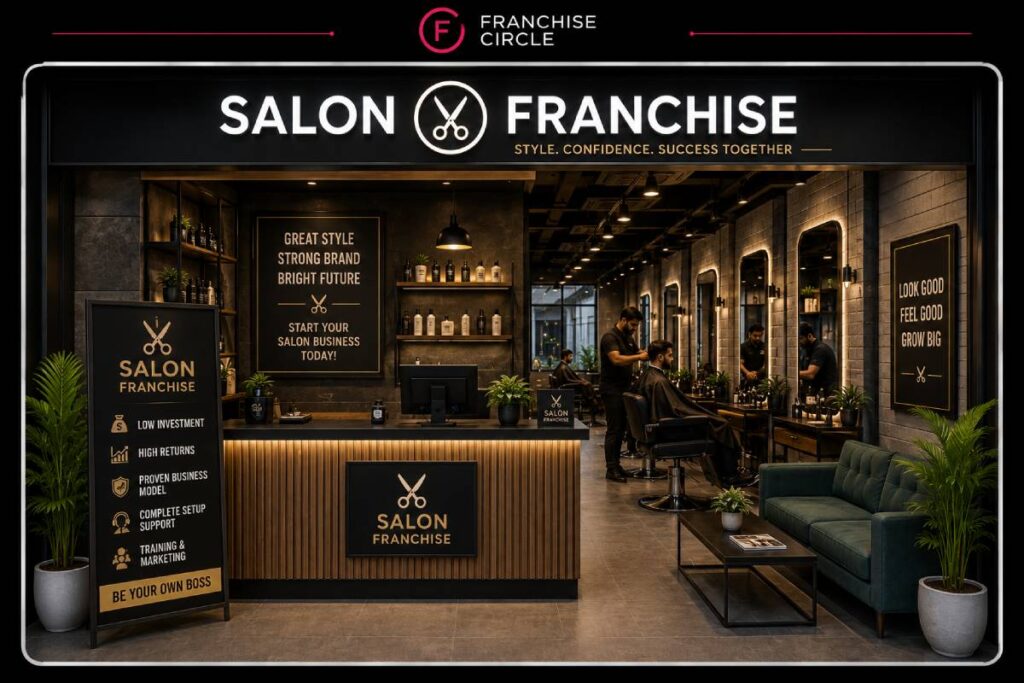
How a Salon Franchise Business Works
Most salon franchises in India operate on a FOFO (Franchise Owned, Franchise Operated) model. The franchisor provides the brand, service menu, staff training curriculum, product line, and marketing support. The franchisee handles the location, hiring, daily operations, and local client base — building on a system that’s already been tested across other cities rather than starting from zero.
After the franchise agreement is signed, the brand’s team typically assists with interior fit-out, initial staff training at the franchisor’s academy, and product stocking before launch. Ongoing support usually includes refresher training for stylists and therapists, seasonal service promotions, and periodic brand visits. The depth of this post-launch support varies noticeably between brands, so it’s worth speaking to existing franchisees specifically about training quality and staff replacement support after the first year.
Royalty structures differ meaningfully across salon brands. Some charge a percentage of monthly revenue — Naturals, for instance, charges around 15% of monthly sales — while others like Lakme Salon work on a lower royalty percentage closer to 5%. Understanding this structure clearly before signing matters, since staff-heavy service businesses like salons run on tighter margins than product-based franchises, and royalty percentage directly affects what you take home each month.
Salon Franchise Investment in India: What to Expect
Salon franchise investment in India typically ranges from around ₹10–25 lakhs for compact, budget-friendly formats to ₹60 lakhs–₹1 crore or more for premium and luxury salon brands. Staff training, interiors, and premium product stocking are the main cost drivers, and actual investment can vary depending on city, location size, and the specific brand’s requirements.
| Format | Investment Range | Typical Breakeven |
|---|---|---|
| Budget / Value Salon | ₹10L – ₹25L | 12 – 18 months |
| Mid-Segment Unisex Salon | ₹25L – ₹50L | 18 – 30 months |
| Premium Brand Salon | ₹35L – ₹60L | 18 – 28 months |
| Luxury Salon & Spa | ₹60L – ₹1Cr+ | 30 – 42 months |
Working capital planning matters as much as setup cost in salon franchising. Staff salaries, rent, and product restocking run from month one, while the client base typically builds gradually over the first year. Most investors should budget for at least six months of operating costs beyond the initial setup. Once a salon reaches stable footfall, net margins can typically range from 20–40%, depending on location, staff retention, and service pricing — though actual results vary by city and brand. Investors exploring the lower end of the salon franchise investment range may also find relevant options in our franchise under 25 lakhs.
Benefits of Investing in a Salon Franchise in India
Recurring & Repeat Clientele Revenue
Haircare and grooming needs repeat every few weeks, unlike many one-time purchase categories. A salon franchise builds a loyal, repeat client base over time, and once that base stabilises, monthly revenue becomes far more predictable than in businesses that depend on constant new customer acquisition.
Large and Still-Growing Market
With India’s beauty and personal care market crossing US$ 26–33 billion and organised salon chains still a small share of it, there’s substantial room for branded growth. Naturals alone operates 800+ locations, and Green Trends runs 375+ salons across 50+ cities — yet unorganised parlours still dominate most neighbourhoods, leaving space for franchised brands.
Multiple Revenue Streams
A well-run salon franchise earns beyond basic haircuts — skincare treatments, bridal packages, product retail, and premium add-on services like colour and spa treatments all contribute to the top line. Brands like Lakme Salon lean heavily into bridal and skincare revenue, which typically carries higher margins than standard services.
Structured Staff Training Support
Skilled staff are the biggest challenge in running a salon, and franchisors solve this directly. Franchisor academies train stylists and therapists to a set curriculum — NSDC-aligned training runs 290–390 hours depending on the role — which meaningfully reduces the franchisee’s burden of building service quality from scratch.
Ready to explore salon franchise opportunities? Get Free Consultation
Popular Franchise Opportunities Across India
Explore verified salon franchise brands across categories and investment levels, available across India
Available Across India
Popular Brands:
- Chai Sutta Bar (₹16L–30L)
- MBA Chai Wala (₹8L–25L)
- Chai Point (₹25L–30L)
- Chaayos (₹6L–11L)
Available Across India
Popular Brands:
- Bikanervala (₹50L–2Cr)
- Haldiram (₹30L–50L)
- Wow Momo (₹15L–30L)
- The Belgian Waffle Co. (₹10–20)
Available Across India
Popular Brands:
- Kidzee (₹10L–15L)
- Bachpan Play School (₹8L–12L)
- EuroKids (₹8L–15L)
- Hello Kids (₹6L–10L)
Available Across India
Popular Brands:
- Barista (₹30L–50L)
- Brewbakes (₹10L–12L)
- Coffee Day Xpress (₹5L–8L)
- Blue Tokai (₹20L–30L)
Available Across India
Popular Brands:
- Cult.fit (₹1.5Cr–2.5Cr)
- Anytime Fitness (₹2Cr–3Cr)
- Gold’s Gym (₹2.5Cr–4Cr)
- Snap Fitness (₹25L–40L)
Service Franchise
Available Across India
Popular Brands:
- DTDC (₹2L–6L)
- Delhivery (₹1L–5L)
- JustDial (₹2L–5L)
- FirstCry Partner Store (₹15L–25L)
Top Salon Franchise Formats Driving Growth in India
Men’s grooming is the standout growth story in Indian salon franchising for 2026. What used to be a basic haircut segment has expanded into skincare, beard treatments, and premium grooming experiences, with barbershop-focused brands opening dedicated outlets specifically for working professionals. This shift is pulling men’s grooming into the same organised-franchise conversation that women’s salons have led for years.
The Tier-2 and Tier-3 expansion story is where the real volume opportunity sits. Cities like Lucknow, Coimbatore, Rajkot, Nagpur, and Indore are seeing rising disposable incomes and growing demand for branded, hygienic salon experiences over traditional unorganised parlours. Competition from established chains is still low in these markets, which means a well-managed salon franchise in a growing residential pocket can build a loyal client base quickly. Investors working with tighter budgets can check our franchise under 50 lakhs page for relevant options.
The premium and luxury salon segment is also gaining ground in metro markets, as consumers increasingly view salon visits as a holistic wellness experience rather than a functional service. International product tie-ins, dermatologist-backed skin treatments, and spa-style ambience are becoming differentiators — brands that invest in this experience layer are commanding higher ticket sizes and stronger client retention than standard-format salons.
Best Cities for a Salon Franchise Business in India
Delhi remains one of the strongest markets for a salon franchise in India — a large, brand-conscious population, high disposable incomes, and dense residential clusters where organised grooming has already replaced the traditional neighbourhood parlour for a big share of consumers. The city’s mix of premium high streets and busy residential markets makes it suitable for almost every salon franchise format, from budget unisex outlets to premium bridal-focused chains.
The broader NCR region — including Noida, Gurgaon, Ghaziabad, and Faridabad — is turning into one of the fastest-growing zones for salon franchise investment. These cities combine strong corporate employment with rapidly developing residential sectors, which means a well-branded salon franchise here can build a loyal client base quickly. Gurgaon in particular has seen strong demand for premium and luxury salon formats given its high-income professional population, while Noida and Ghaziabad offer solid ground for mid-segment unisex salons closer to residential townships.
Mumbai commands some of the highest salon franchise pricing in the country, especially across Bandra, Andheri, and Powai, where clients are willing to pay a premium for both service quality and ambience. The city’s fast-paced lifestyle also means convenience matters — salons located close to residential and office clusters tend to outperform those requiring a long commute. Bangalore, meanwhile, has one of India’s most style-conscious and brand-aware working populations, making it a strong market for both mainstream unisex salons and specialised grooming studios targeting the city’s large IT and startup workforce.
Beyond the metros, Tier-2 cities like Lucknow, Jaipur, Indore, Coimbatore, Rajkot, and Nagpur are becoming increasingly attractive for salon franchise investment in India. Rising disposable incomes, growing brand awareness, and meaningfully lower real estate costs than metro cities all work in an investor’s favour here. Organised competition in these cities is still limited, which means a well-managed salon franchise often builds a stable client base — and reaches breakeven — faster than a comparable investment in an already-saturated metro market.
Popular Salon Franchise Brands in India
The four brands below represent a range of investment levels and formats. Figures are drawn from multiple independent sources as of 2026 — always verify current investment requirements directly with each brand before committing, as costs vary by city and outlet size.
Jawed Habib (₹15L–30L)
Available Across India
India’s most recognised hairstyling brand — strong training academy network with 45+ academies across India.
Naturals (₹30L–50L)
Available Across India
India’s largest unisex salon chain — 800+ locations nationwide, strong franchisee training support.
Green Trends (₹20L–30L)
Available Across India
Value-focused unisex chain — 375+ salons across 50+ cities, affordable entry investment.
Lakme Salon (₹50L–80L)
Available Across India
HUL-backed premium brand — trusted name in bridal and skincare, strong urban footprint.
Ready to explore salon franchise opportunities? Get Free Consultation
Why Now Is a Good Time to Invest in a Salon Franchise in India
The underlying numbers behind salon franchising in India remain strong heading into 2026. India’s “affluent” consumer segment — currently around 60 million people earning above roughly ₹8.7 lakhs annually — is growing at close to 12% a year and is projected to nearly double to about 100 million by 2027. That rising spending power flows directly into grooming and beauty services, which are increasingly treated as routine rather than occasional.
Government support is also adding tailwind to the sector. Initiatives like Startup India and the Production Linked Incentive (PLI) scheme for manufacturing are encouraging domestic beauty product innovation, while the revised MSME framework — allowing micro enterprises to operate with up to ₹2.5 crore investment — is making it easier for local entrepreneurs to access credit and formalise salon businesses. Combined with rising urbanisation, this policy backing has helped push organised salon franchising from a metro-only trend to a genuinely pan-India opportunity.
The competitive window in Tier-2 and Tier-3 cities is still open but narrowing. Established brands are actively expanding into smaller cities with dedicated franchise programmes, and investors entering these markets now are likely to face meaningfully less competition from branded salons than those who wait a few years. In fast-growing residential areas of these cities, a well-managed salon franchise often reaches breakeven faster than a comparable metro investment, simply because local alternatives are still largely unorganised.
Still have questions about tea franchising? Talk to Our Franchise Expert. Talk to Our Experts
How to Choose the Right Salon Franchise in India
Choosing the right salon franchise in India means balancing brand strength against your budget, target city, and how hands-on you want to be in daily operations. Salon franchising ranges widely — from a compact budget outlet to a premium bridal and skincare destination — and getting this evaluation right upfront matters, since a wrong brand or location choice is harder and costlier to unwind in a staff-heavy service business like this than in most other franchise categories.
Check Brand Reputation
Visit three or four running outlets and check client footfall, staff behaviour, and service quality. Talk to existing franchisees about real earnings and how the brand supported them after launch — not just during the sales pitch.
Understand Total Investment
The franchise fee is usually the smallest part of the cost — interiors, equipment, and initial product stock add up fast. Ask for an itemised cost sheet and budget separately for six months of working capital before breakeven.
Review Support System
Staff training quality drives client retention in a salon. Ask specifically about the franchisor’s academy, how often training is refreshed, and how staff replacements are handled mid-year.
Analyze Market Demand
Salon choices are hyper-local — most clients pick one within a short radius of home or work. Map residential density, count existing salons nearby, and check footfall patterns before signing.
Why Trust Franchise Circle?
Registered MSME
Franchise Circle operates as a registered MSME entity, giving investors a verifiable, accountable business to work with.
Franchise Consultants
Our team works directly with investors to match budget, location and risk appetite against the right franchise opportunity.
Brand Verification Process
Every franchise brand listed goes through a basic verification step before being added to our directory.
PAN India Presence
From metro cities to emerging Tier 2 markets, our network covers franchise opportunities across India.
Franchise Circle In Numbers
500+
Franchise Opportunities
2000+
Investors Assisted
100+
Brands Listed
PAN India
Support Network
Franchise Categories Comparison
Compare popular franchise categories — including tea, food, education, coffee, salon and service — based on investment level, risk factor and expected return on investment.
| Category | Investment Level | Risk Level | Typical ROI Period |
|---|---|---|---|
| Food Franchise | Medium to High | Medium | 12 – 24 months |
| Tea Franchise | Low to Medium | Low | 8 – 14 months |
| Education Franchise | Low to Medium | Low | 12 – 18 months |
| Coffee Franchise | Medium | Medium | 12 – 20 months |
| Salon Franchise | Low to Medium | Low | 10 – 16 months |
| Service Franchise | Low | Low | 6 – 12 months |
Expert Reviewed Content
The content on this page has been reviewed by Franchise Circle’s in-house consultants. Market data cited from IBEF and independent industry research on India’s salon and beauty sector. Investment figures are cross-referenced from multiple independent sources and verified before inclusion. We update these pages as market conditions change.
Author Profile
The Franchise Circle team brings together franchise consultants with over five years of direct experience helping investors across India evaluate, compare, and connect with verified franchise brands. Our approach prioritises honest, research-backed guidance over referral-driven recommendations — so investors can make decisions with confidence.
Franchise Consultants
Expert franchise consultants helping investors choose suitable business opportunities.
MSME Registered
Franchise Circle is a registered MSME supporting entrepreneurs and franchise investors.
5+ Years Experience
Providing franchise consulting and investment guidance for over 5 years.
2000+ Investors Assisted
Helping investors discover profitable franchise opportunities across India.
Reviewed by Franchise Circle Consultants
Related Franchise Resources
Explore additional franchise resources and investment opportunities:
Frequently Asked Questions
What is a salon franchise and how does it work in India?
A salon franchise lets you operate a beauty and grooming outlet under an established brand’s name, service menu, and training system. The franchisor provides staff training, product lines, and marketing support, while you manage the location, hiring, and daily operations under a franchise fee and royalty arrangement.
How much does it cost to start a salon franchise in India?
Investment varies by format. A budget or value salon can typically be started for ₹10–25 lakhs, a mid-segment unisex salon for ₹25–50 lakhs, and a premium brand salon for ₹35–60 lakhs. Luxury salon and spa formats can require ₹60 lakhs to ₹1 crore or more.
Which salon franchise is best for investment in India in 2026?
There’s no single best answer — it depends on your budget, target city, and goals. Jawed Habib and Naturals offer strong brand recognition at accessible investment levels, while Lakme Salon suits investors targeting premium bridal and skincare clients. Profitability depends more on location and operations than brand name alone.
What is the breakeven period for a salon franchise in India?
Breakeven timelines vary by format and location. Budget salons may typically break even in 12–18 months, while mid-segment and premium salons often take 18–30 months. Full return on the initial investment can take up to 36–48 months depending on the brand and city tier.
Do I need beauty industry experience to own a salon franchise?
No. Most salon franchise brands train and certify your staff through their own academies. What matters most as a franchisee is operational management, the ability to retain trained staff, and consistent local marketing — not personal expertise in hairstyling or skincare.
How much space is needed to start a salon franchise in India?
Space requirements vary by format. A budget or express salon typically needs 500–1,000 sq. ft. A mid-segment unisex salon usually requires 1,000–2,000 sq. ft. Premium and luxury salons can need 2,000–4,000 sq. ft. or more, depending on service range.
Which cities are best for salon franchise investment in India?
Delhi-NCR, Mumbai, and Bangalore are the strongest metro markets for salon franchising. Tier-2 cities like Lucknow, Jaipur, Indore, Coimbatore, and Rajkot are increasingly attractive, offering lower competition from branded chains and lower entry costs for 2026 investment.
What royalty fees do salon franchises charge in India?
Royalty structures vary by brand — some charge a percentage of monthly revenue, such as Naturals’ approximately 15% royalty, while others like Lakme Salon charge a lower percentage closer to 5%. Always clarify the full fee structure, including marketing and training fees, before signing.
Is a salon franchise profitable in India?
A well-managed salon franchise in a good location can be profitable, with net margins that may typically range from 20–40% once footfall stabilises. Actual results vary depending on location, staff retention, rent levels, and service pricing strategy.
Can I start a salon franchise under ₹25 lakhs in India?
Yes — budget and value-focused salon formats are available in this range, along with certain compact grooming studio models. Our franchise under 25 lakhs guide covers available options at this investment level.
What are the main risks of investing in a salon franchise in India?
The biggest risks are staff-related — high attrition and skill shortages can affect service consistency and client retention. Location, rent share of revenue, and working capital planning in the first year are also important factors. Speaking with existing franchisees before signing is the most effective way to reduce this risk.
How can Franchise Circle help me find the right salon franchise?
Franchise Circle maintains a verified database of salon and beauty franchise opportunities across budget, mid-segment, and premium categories. We help investors match their budget, city, and goals with the right brand and connect them directly with franchisor teams.
Need personal guidance? Contact our franchise consultants.